
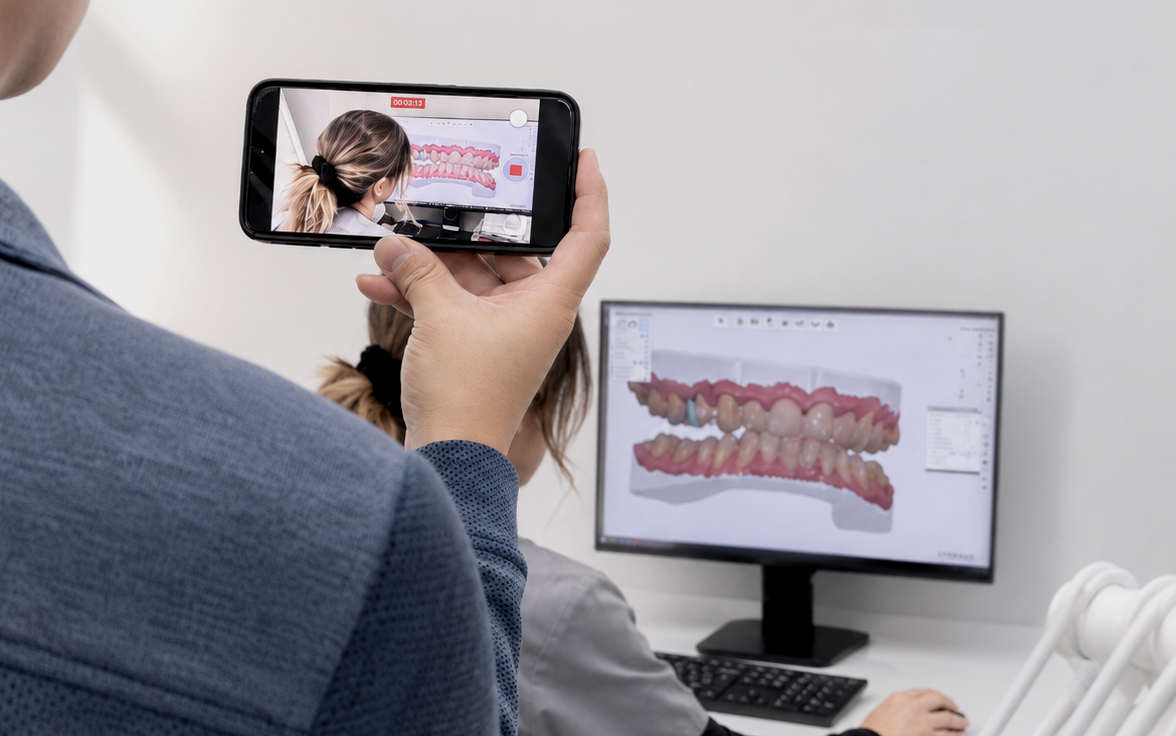
Hands-On Dental Course | Level 5
Finish the Case
Managing Orthotic Therapy and Choosing Phase 2
Know when Phase 1 is complete, and choose the Phase 2 that makes the correction permanent.
Level 5 completes the case. Level 4 established the corrected position and held it with an adjusted orthotic. Level 5 covers what happens next: managing orthotic therapy through to the end of Phase 1, then choosing and sequencing the Phase 2 treatment that makes the corrected position permanent.
The orthotic holds the position, but it does not hold it forever. The patient changes over the course of therapy: the muscles release, the joint heals, and the mandible changes position. You will learn to read those changes, to modify the orthotic as the position settles, and to recognize when Phase 1 is complete. From there, the level breaks down Phase 2: orthodontics, restorative and prosthodontic treatment, occlusal equilibration, and surgical referral. You will learn which case calls for which, how to combine them, and how to sequence the finalization so that the position the orthotic established is transferred to the dentition and held without the appliance.
Learning objectives
Upon completion, participants will be able to:
Manage orthotic therapy across the course of Phase 1, and modify the orthotic as the mandibular position settles.
Distinguish expected settling from a problem that requires intervention.
Reassess the position over time using TENS, bite registration, and imaging when it is indicated.
Recognize when Phase 1 is complete: a stable position, resolved or plateaued symptoms, and a repeatable occlusion.
Explain how Phase 2 transfers the corrected position from the orthotic to the dentition.
Select among the Phase 2 options - orthodontics, restorative and prosthodontic treatment, equilibration, and surgical referral - for a given case.
Determine when surgical referral is indicated, and the limits of what orthotic and restorative treatment can achieve.
Sequence a Phase 2 plan that holds the corrected position long-term.
Course details
Location: Smiles by Bis
710 Dorval Dr #220, Oakville, ON L6K 3V7
Date: To be announced
CE Credits: 14
Dentist tuition: $5,995 CAD
Hygienist or assistant: $980
Format: Two-day, in-person course
Course content
-
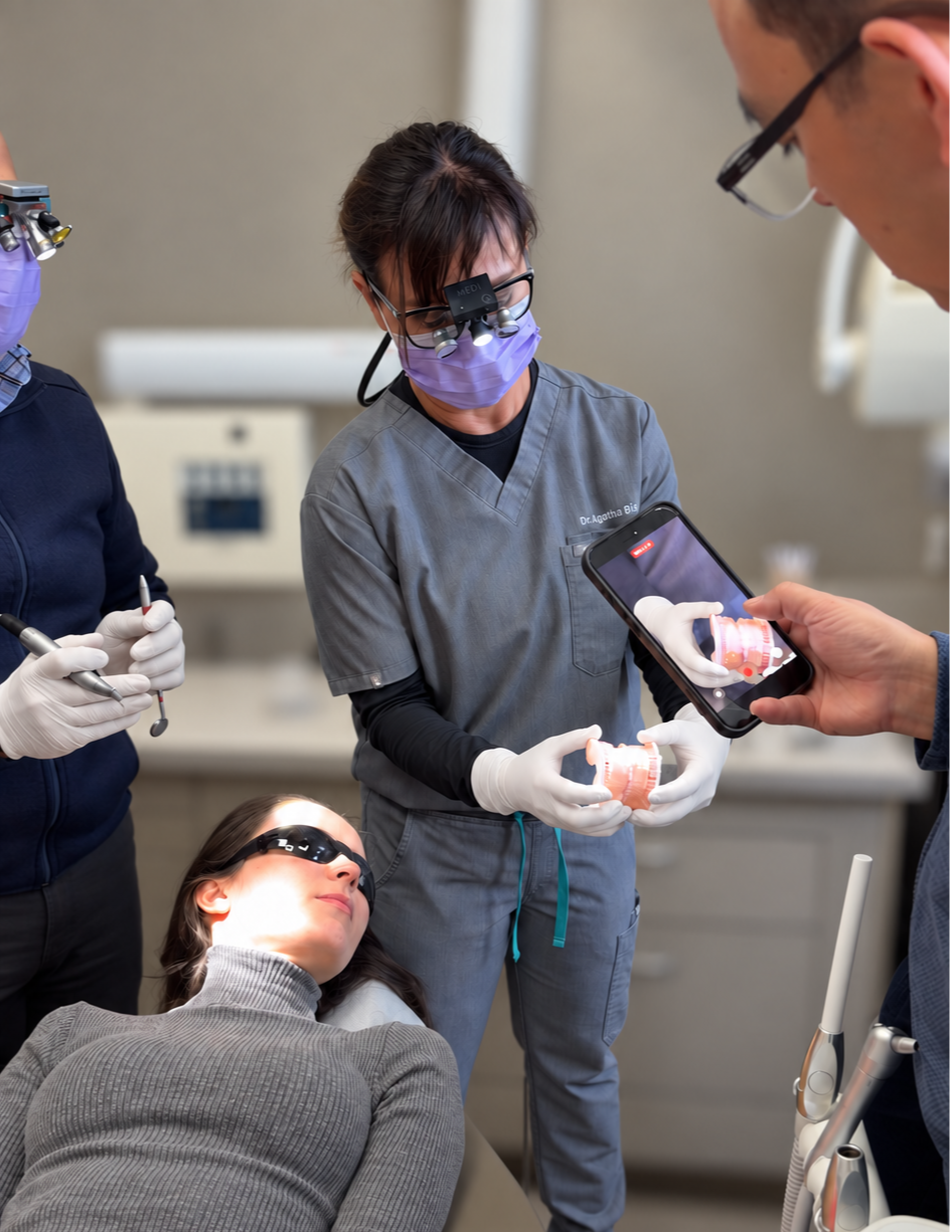
The orthotic changes the patient, and the patient does not change all at once. Over the weeks and months of Phase 1, the muscles release, the joints heal, and the symptoms resolve or change. As they do, the mandible position changes with them. This module teaches you what to expect over the course of therapy, so that a change in mandibular position reads as progress or as a problem, not as a surprise.
-
A contact that was correct at delivery is not correct once the mandible has moved. This module teaches you to re-read the occlusion at each visit and to modify the orthotic as the position settles: which contacts to adjust, when to add and when to reduce, and how to keep the orthotic at the corrected position as that position changes.
-
The corrected position has to be confirmed, not assumed. This module teaches you to reassess over time - repeating TENS and bite registration, and repeating imaging when it is indicated - to confirm the position is stable and the joint and muscles have responded.
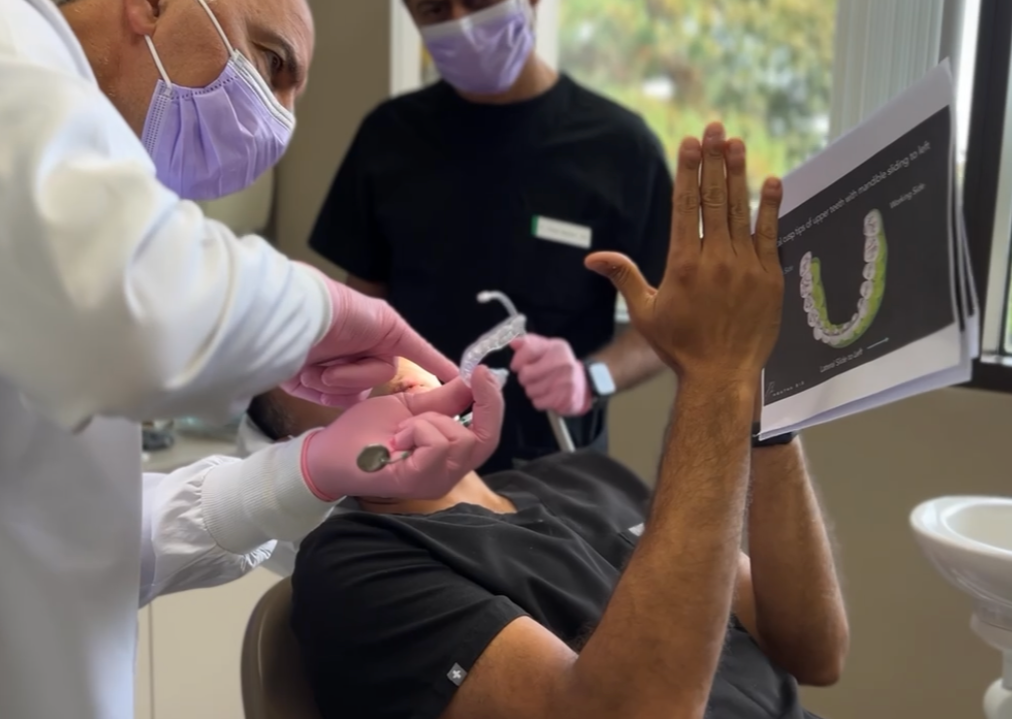
Material is removed where the mandible indicates, not where it is convenient to reach. That requires you to move the mandible. You guide the patient through the excursive and protrusive slides, recognize when the patient is not producing them, and lead them through until the contacts present themselves. A patient who guards, or who closes into the position they have held for years, will not deliver those marks unassisted. This module teaches how to direct the adjustment: which contacts to remove and in what order, how to move the mandible so the correct contacts appear, and how to verify that the position has been reached rather than approximated.
Reducing acrylic is not adjustment. Knowing where the reduction belongs is.
This module teaches you to determine the target mandibular position the case requires - the corrected position toward the Optimal Physiologic Position - using TENS to locate it and an accurate bite registration to capture it. The position is the objective; everything that follows is how you reach it.
-
Phase 1 ends when the position is stable, the symptoms have resolved or plateaued, and the occlusion on the orthotic is repeatable. This module teaches you to judge that endpoint, to document it, and to decide what the case needs next. That decision is the start of Phase 2.
-
The orthotic holds the corrected position, but it is removable and temporary. Teeth are the stops that set where the mandible closes; the orthotic replaced those stops. Phase 2 puts permanent stops back into the dentition, so the corrected position is held without the appliance. Every Phase 2 option is a different way to do that.
-
Phase 2 has four routes: orthodontics, restorative and prosthodontic treatment, occlusal equilibration, and surgical referral. This module covers what each one does and which case it fits. Orthodontics moves the teeth to the corrected position. Restorative and prosthodontic treatment rebuilds the teeth to it. Equilibration adjusts the existing teeth to it, within limits. Surgical referral addresses the cases the other three cannot. The audience already has restorative training, so the focus here is the decision, not the execution.
-
Most complex cases need more than one route. This module teaches you to choose among the options for a given case and to combine them: when orthodontics precedes restorative treatment, when equilibration is enough and when it is not, and when the case has reached the limit of what dentistry can do and requires surgical referral.
-
The order of Phase 2 treatment determines whether the corrected position holds through the transition. This module teaches you to sequence the finalization: what comes first, what depends on what, how to hold the position as the orthotic is withdrawn, and how to retain the result long-term.
Hands-on practical exercises
Reading a changing bite across sequential records
Modifying an orthotic to a settled position on models
Combining Phase 2 options: building a combined plan
Communication with patient
Sequencing workshop: ordering a Phase 2 plan from a completed Phase 1 case
Compromised treatment planning workshop: re-sequencing the plan when the patient declines a component - the case that requires orthodontics before restorative treatment and a patient who refuses the orthodontic phase. What remains achievable, what the compromise costs, how it is documented, and where the line falls between a compromised plan and one that should not be undertaken.
Your Monday-morning toolkit
Every level ends with a single-page tool you can apply the next working day. It is not a course summary. It is an instrument, built for chairside use by you and your team.
Level 5 - The Phase 2 Decision and Sequencing Guide.
A one-page instrument that first confirms the Phase 1 completion criteria are met, then maps the Phase 2 routes - orthodontics, restorative and prosthodontic treatment, equilibration, surgical referral - to the features of the case, and sets the sequence with its dependencies. It takes you from a completed Phase 1 to a Phase 2 plan and its order.

Bringing a team member
Phase 1 runs over months, and Phase 2 involves several appointments and often outside providers. The team manages that: the recall and reassessment schedule, the records at each visit, and the coordination with the lab or the specialist when Phase 2 begins. A team member trained here keeps long cases from stalling between phases, which is where many of them are lost.
The economics of finishing the case
Level 5 is where the case is completed or left unfinished. The difference is most of the value in the case. Three drivers follow from the material.
Phase 2 is the largest treatment in the case. The finalization - orthodontic, restorative, or prosthodontic, or a combination - is where most of the production sits. It is realized only when Phase 1 is completed correctly and the Phase 2 route is chosen well. A case that stalls at the orthotic never reaches this point.
A finished case holds; an unfinished one relapses. The corrected position is temporary until it is made permanent. A case left on the orthotic, or finalized in the wrong sequence, relapses, and the work and the patient's trust are lost with it.
The right route, not the most treatment. Choosing among the Phase 2 options means matching the treatment to what the case requires: equilibration when that is sufficient, orthodontics when the teeth must move, restorative treatment when they must be rebuilt, or a combination of these when the combination produces a better, more conservative, or more cost-effective result. Matching the route to the case avoids both over-treatment and repeated correction.
Ready to take the case beyond the orthotic?
Level 5 teaches you how to manage the patient through the end of Phase 1, recognize when the corrected position is stable, and choose the Phase 2 treatment that will hold that position long-term.
New to the Hands-On Series? Start with Level 1 to build the diagnostic foundation first.
Bridge to Level 5
Level 5 completes the standard complex case, from orthotic through Phase 2. Level 6 addresses the hardest cases: full-mouth reconstruction, cases that combine several disciplines, and cases that have failed previous treatment and must be diagnosed and rebuilt from the beginning.
Have a question before registering?
Not sure which level is right for you, what to expect, or whether you should bring a team member? Send us your question and our team will get back to you.

About the instructor
Dr. Agatha Bis has spent nearly 30 years treating complex cases in private practice with a clinical focus on TMJ disorders, occlusion, restorative dentistry, and the systems that make treatment more predictable. She is also the founder of TMJ Whisperer Academy, an educational platform built for dentists who want to understand cases more clearly, diagnose with more confidence, and practice with more control.