

Hands-On Dental Course | Level 4
Plan the Complex Case
When to Use an Orthotic, and Where to Position the Mandible for Complex Cases
Know when a complex case calls for an orthotic, the mandibular position it must hold, and how to adjust it without losing its anatomy.
COURSE FULL
Level 4 is where the orthotic becomes a treatment decision rather than a default. Two questions come first: does this complex case call for an orthotic, and what mandibular position should it hold. The answers come from the diagnosis.
Most dentists adjust an appliance by removing acrylic until the surface is flat and even. That is not orthotic adjustment. An orthotic is adjusted in small, precise steps, in the target mandibular position and in every excursive movement, and its anatomy is kept, not flattened. Dentists practise this in pairs: one adjusts, the other is the patient, and then they switch.
Learning objectives
Upon completion, participants will be able to:
Treatment-plan a complex case and define the role of Phase 1 orthotic therapy within it.
Determine when an orthotic is indicated, and when another route is appropriate.
Establish the target mandibular position, toward the Optimal Physiologic Position, and verify it with TENS and an accurate bite registration.
Deliver the orthotic and establish even, simultaneous bilateral contacts in the target position.
Adjust the orthotic in protrusive and lateral excursions, removing working and balancing interferences.
Make small, precise adjustments that keep the anatomy of the orthotic.
Guide the patient through each movement so that the correct contacts present, including the patient who guards.
Confirm that the orthotic reproduces the target position.
Course details
Location: Smiles by Bis
710 Dorval Dr #220, Oakville, ON L6K 3V7
Date: To be announced
CE Credits: 14 (6.75 lecture, 7.25 participation)
Dentist tuition: To be announced
Hygienist or assistant: To be announced
Format: Two-day, in-person course
Course content
-
The complex case needs a plan before a procedure: the sequence of correction, the role of Phase 1 within it, and where the case is going. Without the plan, the orthotic has no defined objective.
-
Not every complex case calls for an orthotic. This module teaches which findings call for repositioning the mandible with an orthotic, and which call for another route.
-
The orthotic is built to a position. This module teaches you to locate the target mandibular position, toward the Optimal Physiologic Position, with TENS, and to capture it with an accurate bite registration.
-
Adjusting an appliance usually means removing acrylic until the surface is flat. An orthotic adjusted that way loses the anatomy that holds the mandible in position. Orthotic adjustment is a series of small, precise corrections, and the anatomy is kept.
-
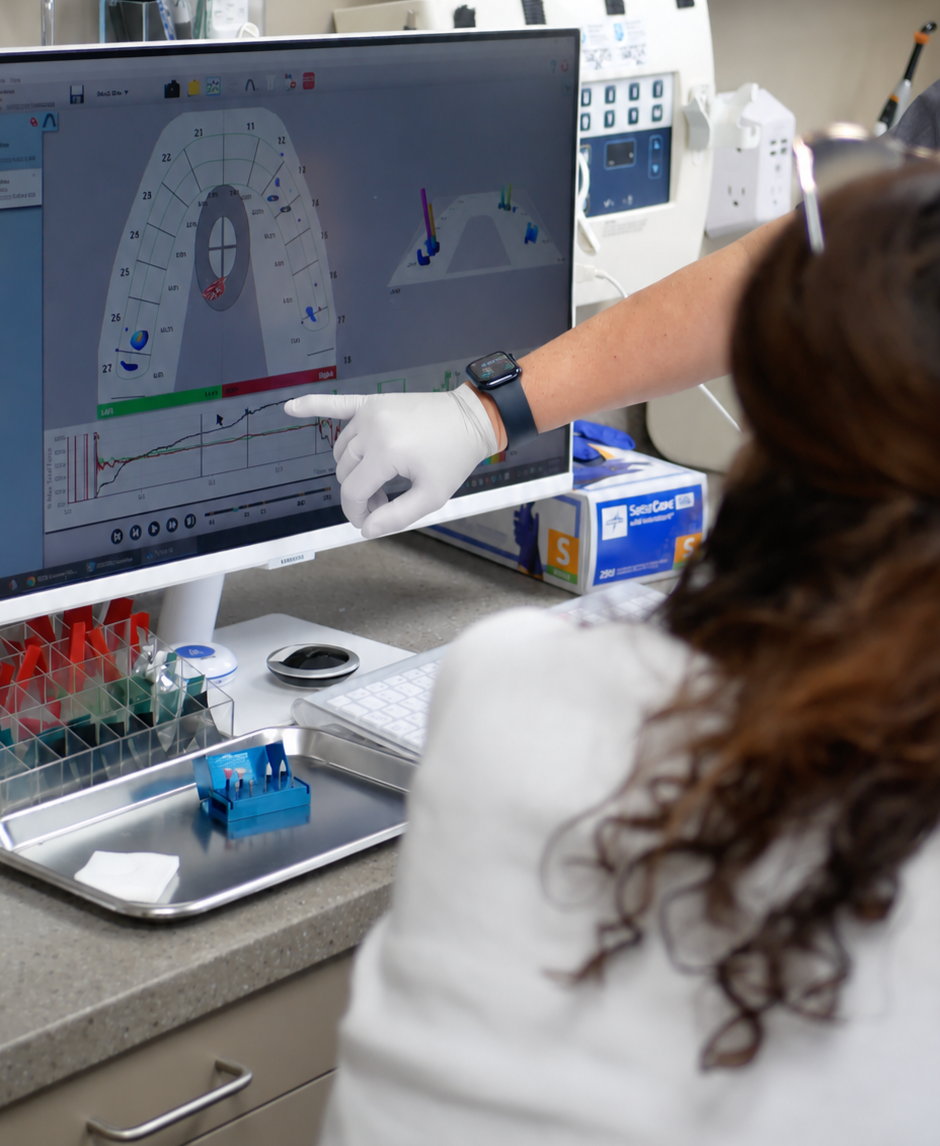
Teeth are the stops that set where the mandible closes and where the condyle seats; the orthotic replaces those stops. It is adjusted first in the target position, to even, simultaneous bilateral contact, then in protrusive and lateral excursions, where working and balancing interferences are removed. You learn to guide the patient through each movement, including the patient who guards and closes into the position held for years, so that the correct contacts present.
-
The adjustment is complete when the orthotic reproduces the target position each time the patient closes. This module teaches how to confirm it.
Schedule
-
8:00–8:30am — Registration and breakfast
8:30–9:30am — Lecture: Complex-case treatment planning: the sequence of correction and the role of Phase 1
9:30–10:30am — Breakout 1: Complex-case treatment-planning workshop
10:30–10:45am — Break
10:45–11:30am — Lecture: When an orthotic is indicated, and when another route is appropriate
11:30am–12:30pm — Breakout 2: Orthotic indication decision exercise
12:30–1:30pm — Lunch
1:30–2:30pm — Lecture: Determining and verifying the target mandibular position with TENS and bite registration
2:30–3:30pm — Breakout 3: Locating and recording the target position with TENS and bite registration, in pairs. Team members assist
3:30–3:45pm — Break
3:45–4:30pm — Lecture and video: Orthotic design workflow for in-office printing, and laboratory communication
4:30–5:00pm — Day 1 review and questions
5:00–6:00pm — Cocktails and hors d'oeuvres
-
8:00–8:30am — Registration and breakfast
8:30–9:30am — Lecture: Adjustment is not flattening. Delivery and adjustment in the target position: even, simultaneous bilateral contacts
9:30–10:45am — Breakout 4: Orthotic delivery and adjustment in the target position, in pairs
10:45–11:00am — Break
11:00–11:45am — Lecture: Adjusting in protrusive and lateral excursions. Working and balancing interferences. Guiding the patient through each movement
11:45am–12:45pm — Breakout 5: Adjustment in protrusive and lateral excursions, in pairs
12:45–1:45pm — Lunch
1:45–2:30pm — Lecture: Precise adjustment without loss of anatomy. Confirming that the orthotic reproduces the target position
2:30–3:30pm — Breakout 6: Completing and verifying the adjustment, in pairs
3:30–3:45pm — Break
3:45–4:45pm — Review of cases submitted by attending dentists
4:45–5:00pm — Introduction to Level 5. Evaluations and certificates
How the breakouts work. Before the course, each participant submits digital scans of their own arches, and an orthotic is printed in our office from those scans. Dentists work in pairs: one dentist adjusts, the other is the patient, and then they switch. Team members act as the assistant.
Bring your own cases. Attending dentists may submit their own cases for review on Day 2. Instructions are sent after registration.
Hands-on exercises
Complex-case treatment-planning workshop
Orthotic indication decision exercise
Locating the target mandibular position with TENS, and bite registration
Orthotic delivery: even, simultaneous bilateral contacts
Adjustment in protrusive and lateral excursions, in pairs
Precise adjustment without loss of anatomy
Confirming that the orthotic reproduces the target position

Your Monday-morning toolkit
Every level ends with a single-page tool you can apply the next working day. It is not a course summary. It is an instrument, built for chairside use by you and your team.
Level 4 - The Target-Position Adjustment Protocol.
A one-page sequence for the adjustment appointment: confirm the indication, record the target position and how it was verified, adjust in the target position, adjust in each excursive movement, and confirm that the orthotic reproduces the position.

Bringing a
team member
Team members attend as the assistant. During the breakouts they assist the adjusting dentist: they set up TENS and bite registration materials, manage articulating paper and instruments, record the contacts, and prepare the patient for what the appointment asks of them.
A trained assistant keeps the adjustment appointment efficient, so your chair time is spent on the position and the adjustment.
The economics of complex-case treatment
Level 4 is where the difficult case is either planned, treated, and kept, or referred out. The decisions in this level determine which. Three drivers follow from the material.
Complex cases treated, not referred away. The ability to plan and execute the difficult case keeps it in your practice. Each complex case referred out is production lost, and a patient relationship, handed to someone else.
The orthotic used when it is indicated, not by default. An orthotic placed in a case that did not need one, or adjusted to the wrong position, is time and money spent without a result. Choosing it deliberately, and building it to the correct position, is what makes Phase 1 orthotic therapy effective and productive.
Phase 1 done right carries the case to Phase 2. The finalization work follows Phase 1. When the position is correct and the case responds, it proceeds to Phase 2 — the larger case. When it is not, the patient stalls and that case is lost.
Put the diagnosis
into action
Level 4 takes the complex case from treatment planning into Phase 1 therapy: when an orthotic is indicated, the position it must hold, and how to adjust it precisely in every movement.
New to the Hands-On Series? Start with Level 1 to build the diagnostic foundation first.
Bridge to Level 5
Level 4 establishes the corrected position and the plan for the complex case. Level 5 follows the case beyond that point: how the patient changes over time after orthotic therapy, and Phase 2, the finalization that makes the corrected position permanent, through orthodontics, restorative and prosthodontic treatment, equilibration, or surgical referral.
Have a question before registering?
Not sure which level is right for you, what to expect, or if you should bring a team member? Send us your question and our team will get back to you.

About the instructor
Dr. Agatha Bis has spent nearly 30 years treating complex cases in private practice with a clinical focus on TMJ disorders, occlusion, restorative dentistry, and the systems that make treatment more predictable. She is also the founder of TMJ Whisperer Academy, an educational platform built for dentists who want to understand cases more clearly, diagnose with more confidence, and practice with more control.