

2026-07-23
Dentist Burnout Is Not Just About Being Busy
Written by Dr. Agatha Bis
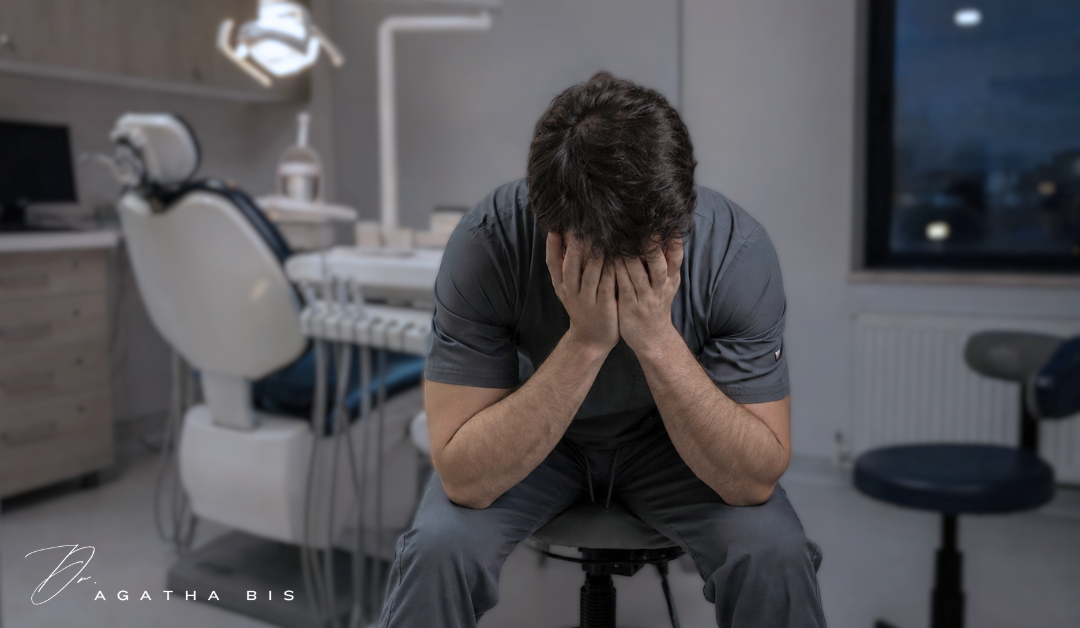
Dentists are used to being tired.
That is not new.
What is new is the kind of exhaustion many clinicians are describing.
It is not just physical fatigue from a full day of procedures. It is emotional fatigue from constant vigilance. It is the pressure of being clinically responsible, financially responsible, legally exposed, publicly reviewed, and expected to remain calm through all of it.
Dentist burnout is not simply about working too many hours.
It is about practicing in an environment where the dentist feels they cannot fully breathe.
The modern dentist carries multiple burdens at once.
There is the clinical burden: diagnosis, treatment planning, execution, complications, outcomes.
There is the business burden: staffing, overhead, supplies, rent, software, marketing, insurance, collections.
There is the emotional burden: anxious patients, mistrust, unrealistic expectations, and the fear that one difficult interaction may become a public review.
There is the regulatory burden: documentation, standards, complaints, investigations, and the awareness that even careful decisions can be judged later.
This is why burnout in dentistry feels different from ordinary stress.
Stress says, “Today was hard.”
Burnout says, “I do not know how long I can keep practicing like this.”
The article “The Erosion of Clinical Autonomy and the Rise of Defensive Practice” describes dentists who feel like they are becoming risk managers instead of clinicians. That sentence captures the crisis.
Most dentists did not enter the profession to spend their days protecting themselves.
They entered dentistry to help patients, solve problems, build skill, and practice with judgment.
But when fear becomes constant, the work changes.
A dentist may avoid complex cases. They may stop offering comprehensive options. They may refer more, not because the referral is clinically necessary, but because the case feels emotionally unsafe. They may become quieter in their diagnosis, more hesitant in their recommendations, and less willing to take on treatment that requires nuance.
That is not a character flaw.
It is a predictable response to an overloaded system.
Burnout also thrives in isolation. Many dentists work in environments where they carry the full weight of decisions alone. They may not have a trusted group to discuss difficult cases. They may not feel safe admitting uncertainty.
Younger dentists may feel especially exposed, while experienced dentists may feel that the profession they entered is no longer the profession they are practicing.
The solution cannot be reduced to “take a vacation.”
Dentists need rest, yes.
But they also need professional clarity.
They need better diagnostic frameworks so complex cases feel less chaotic. They need communication tools to explain findings without sounding defensive. They need communities where clinical judgment is strengthened, not shamed. They need continuing education that addresses the real pressures of practice, not only the technical steps of a procedure.
Burnout is not only a wellness issue.
It is a clinical issue.
A burned-out dentist is more likely to avoid complexity, rush communication, narrow treatment options, or disconnect emotionally from patients.
Supporting dentists is not separate from supporting patient care. It is part of it.
The future of dentistry depends on whether clinicians can return to a healthier question:
Not “How do I survive this day?”
But “How do I practice with clarity, confidence, and integrity?”
That is the kind of dentistry patients need.
And it is the kind of dentistry dentists deserve.
Want the deeper context behind defensive dentistry and clinical autonomy?
Read the full article here: The Erosion of Clinical Autonomy and the Rise of Defensive Practice
References:
American Dental Association. Feeling burned out? You’re not alone. ADA News, 2024.
American Dental Association. ADA extends Well-Being Index to dental team members. ADA News, 2025.
Maragha, T., et al. Dentists’ Mental Health: Challenges, Supports, and Promising Practices. National Library of Medicine / PMC, 2024.
Rhoades, K. A., et al. Patient aggression toward dentists. Journal of the American Dental Association, 2020.
Dental Protection. Two-thirds of dental professionals “burnt out and exhausted.”