

2026-06-19
The Erosion of Clinical Autonomy and the Rise of Defensive Practice: A Multi-Decadal Analysis of the Dental Profession in North America
By Agatha Bis, DDS
TMJ Whisperer Academy
Introduction
I’ve been in dentistry for 30 years, and in that time, I’ve witnessed a transformation that few other professions have experienced at this pace. Access to information has accelerated learning curves. Digital workflows, CBCT imaging, CAD/CAM systems, and AI-driven diagnostics have increased precision and expanded what is clinically possible. Today’s dentist can diagnose more accurately, plan more comprehensively, and execute treatment with a level of predictability that was unimaginable decades ago.
On the surface, this looks like progress - and in many ways, it is.
But progress has come with a cost.
In conversations with dentists across North America, a different narrative continues to emerge - one that is far less optimistic. The profession is no longer defined solely by clinical growth, but by a growing sense of pressure. Dentists describe feeling overwhelmed, stressed, and increasingly anxious. The doctor-patient relationship has shifted, complicated by misinformation and a digital culture that often undermines clinical expertise. Patients arrive armed with half-truths and quick fixes, challenging sound treatment recommendations.
Yet the most concerning shift is not technological or economic - it is psychological.
There is a palpable rise in fear within our profession.
Dentists are avoiding treatment, not because they lack the skill or knowledge, but because the perceived risk is too high. Fear of regulatory scrutiny, fear of complaints, fear of reputational damage, and fear of disciplinary action have begun to dictate clinical decisions. Many feel they have no voice. Others feel trapped in a system where the consequences of doing the right thing can outweigh the benefits to the patient. Some are even questioning their future in dentistry altogether.
Hearing the same concerns repeatedly from colleagues at different stages of their careers led me to look deeper. What is driving this shift? Why are capable, well-trained clinicians stepping back from the very work they were trained to do?
This article explores that question.
It is an examination of the erosion of clinical autonomy and the rise of defensive practice in dentistry - trends that are not anecdotal, but systemic, and increasingly difficult to ignore.
The contemporary practice of dentistry in North America, and specifically within the province of Ontario, is currently navigating a period of unprecedented systemic volatility. Over the last fifty years, the profession has undergone a radical transformation, shifting from a localized "cottage industry" defined by high clinical autonomy and stable practitioner-patient relationships into a high-pressure, high-compliance environment characterized by a documented "climate of fear". This analysis examines the multifaceted stressors currently besieging the dental workforce, focusing on the economic fiscal squeeze, the adversarial nature of the modern patient relationship, and the punitive shift in the regulatory landscape. By synthesizing historical trends with contemporary mental health data, it becomes evident that the modern dentist is no longer merely a clinician but a risk manager operating within a complex web of financial, reputational, and regulatory liabilities.
The Fifty-Year Metamorphosis: 974 to 2024
In the mid- 970s, dentistry in Canada and the United States was largely a reactive discipline centered on treating oral pathologies as they manifested.⁵ The practitioner of 974 operated within a professional ecosystem that favoured the solo owner-operator, a model where the dentist held total clinical autonomy and served as the primary arbiter of oral health within their community.⁶ This era was marked by a lack of complex regulatory oversight; in the early 20th century, for example, dental regulation in the United States was managed by only four institutions, a far cry from the 45 different agencies and boards that now exercise some form of authority over the practice.⁷
The subsequent five decades have seen a transition toward a high-tech, patient-focused field, yet this evolution has carried heavy psychological and administrative costs. While 970s dentistry focused on basic extractions and restorative work, the modern era demands expertise in digital radiography, CAD/CAM technology, laser dentistry, and complex implantology.⁷ These advancements have improved patient outcomes but have simultaneously raised the "baseline of expectation" and the capital investment required to practice, creating a high-debt, high-overhead environment that was virtually unknown to previous generations.⁷
Evolution of Dental Practice Modality ( 970s vs. 2020s)
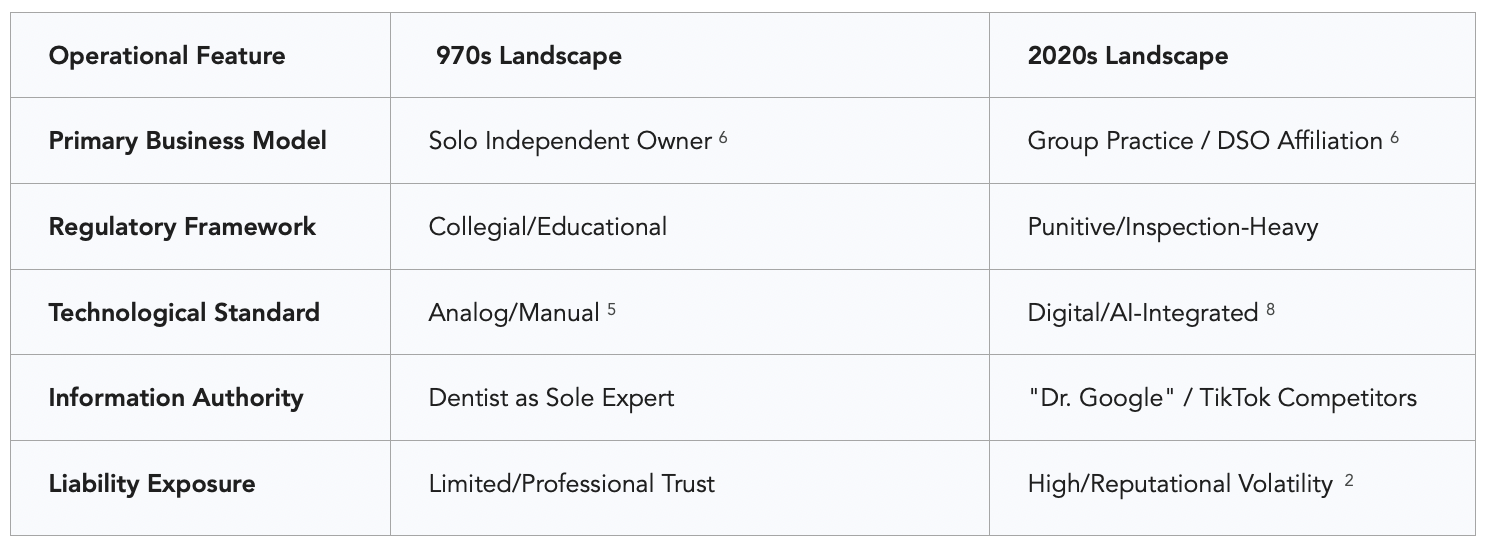
The structural decline of the solo practice model is a primary indicator of these shifting pressures. In the United States, solo ownership dropped from 85% in 2005 to 73% by 2023. ⁴ In Canada, the figures are even more striking, with only approximately one-third of dentists now operating in a solo capacity, as most find the administrative and financial burdens of independent ownership increasingly unmanageable.⁶ This trend is most pronounced among younger dentists under the age of 35, whose ownership rates have nearly halved in the past decade. ⁰
The Macroeconomic Squeeze: Debt, Overhead, and Stagnation
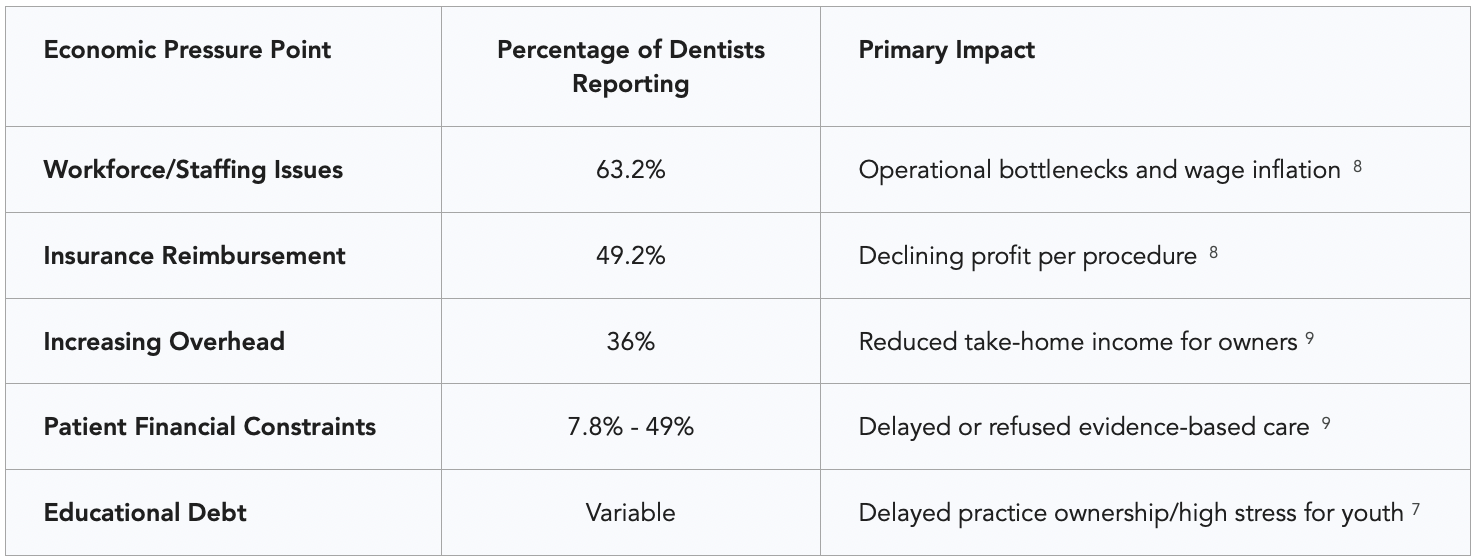
The economic viability of the dental practice is currently being undermined by a "perfect storm" of rising operational costs, lagging insurance reimbursement rates, and significant student debt. ⁵ These factors contribute to a persistent state of overwhelm, particularly for new graduates and solo practitioners who lack the economies of scale available to larger corporate entities.
The Debt-to-Income Disparity
The escalating cost of dental education represents the first major barrier to professional well-being. Over the last 40 years, tuition for private dental schools in the United States has increased 555-fold, while general inflation has increased only 25-fold during the same period.⁷ By 2023, the average dental school debt for graduating seniors reached $280,700.⁷ This initial financial burden forces many new dentists into high-volume environments or Dental Support Organizations (DSOs), where the pressure to meet production targets can conflict with individualized patient care and clinical judgment.⁴
The Ballooning of Operational Overhead
For practice owners, the fiscal pressure is exacerbated by overhead costs that typically consume between 60% and 75% of total revenue.⁴ I believe that number is much higher. Staffing remains the single largest operational challenge, with over 62% of dentists citing recruitment and retention as a top hurdle heading into 2025. ⁷ The cost of labor, particularly for dental hygienists and assistants, has surged as the market remains incredibly competitive following the pandemic. ⁵
Simultaneously, the cost of dental supplies and equipment rose dramatically post-Covid, a trend that many analysts suggest is the "new normal".⁹ When these increasing expenses are paired with insurance reimbursement rates that have remained largely flat or have failed to align with inflation, the profit margin per procedure shrinks. This disparity creates a "fiscal squeeze" where practitioners must see more patients simply to maintain their existing net income, directly contributing to the prevalence of burnout. ⁵
Economic Challenges Reported by North American Dentists (2024-2025)
Regulatory Fear and Defensive Practice
A recurring source of stress for dentists across Canada and the United States is the fear built into the relationship with the bodies that license them - provincial colleges in Canada, state dental boards in the US. The mandate of each is the protection of the public interest. The practical effect on the individual practitioner is an asymmetry of consequences: the disciplinary risk attached to a clinical decision is weighted more heavily than the marginal benefit to the patient. Each decision is made under the awareness that a contravention can constitute professional misconduct.
That fear changes clinical behavior. Practice standards are commonly defined as minimum requirements, but because any contravention can be treated as misconduct, the incentive is to treat each standard as a fixed threshold. Where an individualized treatment plan and a published standard diverge, strict adherence carries the lower personal risk, independent of the clinical merits. Care narrows toward what is defensible rather than what is optimal.
The same fear extends to how dentists speak. Professionalism standards, and advertising rules that restrict claims suggestive of superiority, are often read as discouraging open criticism of the standards themselves. The result is a guarded profession, in which practitioners are cautious about stating plainly what they do well or where they disagree with current policy.
The Adversarial Arena: The Digitally Armed Patient
Beyond economic and regulatory pressures, the modern dentist is increasingly facing a fundamental shift in the patient-provider dynamic. The traditional therapeutic partnership has been eroded by a consumerist model where the patient is often skeptical, empowered by digital misinformation, and prepared to use reputational violence via online reviews.
The Infodemic and TikTok Trends
The rise of platforms like TikTok and Instagram has created what experts call an "infodemic" - the rapid spread of health misinformation that competes directly with clinical training. Patients frequently arrive for consultations having already "self-diagnosed" or researched unproven treatments through influencers with no medical background. Trends such as DIY dental alignment, "oil pulling," or using highly acidic substances like lemon or hydrogen peroxide for whitening are actively damaging the oral health of the public.²³
When a dentist attempts to correct these misconceptions, they are often met with resistance. Patients may interpret evidence-based clinical advice as a "sales pitch," leading to fragmented trust and longer chair-side times spent correcting myths rather than planning treatment. Research indicates that over half of patients sometimes feel that clinical advice is merely "marketing" for a product or service.²⁵ This skepticism makes the provision of care significantly more taxing, as every recommendation must be defended against "Dr. Google."
The Weaponization of Google Reviews
Perhaps the most visceral stressor for the contemporary practitioner is the power of the anonymous online review. Approximately 44.4% of U.S. dentists report experiencing "reputational aggression” - threats of lawsuits or negative social media comments - in just the past year. ³ Over the course of a career, this figure rises to nearly 69%. ³
Negative reviews are often used by patients as a tool for financial negotiation or as revenge for outcomes that were limited by the patient's own refusal of the standard of care.²⁶ Because dentists are bound by strict provincial and federal confidentiality laws, they are often legally "muzzled" and unable to respond to these reviews with the clinical facts necessary to defend their integrity.²⁸ A single negative review, even if demonstrably false, can stand out in a profile and deter potential patients, leading to a state of perpetual anxiety for the practitioner.²⁹
Aggression and Harassment Statistics (US Dentists)
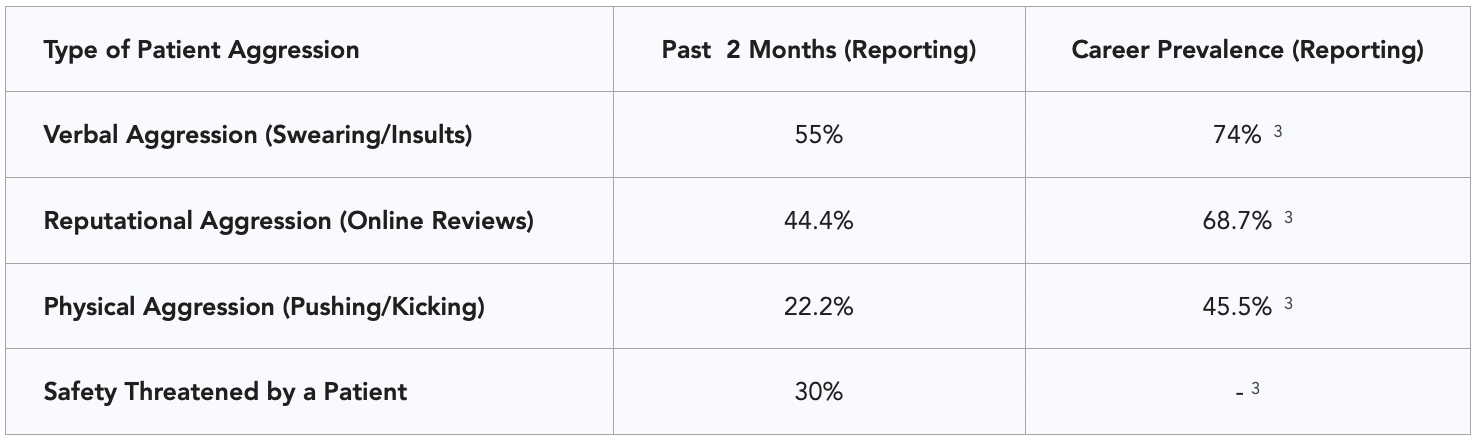
This hostility is not limited to any one demographic. Studies show that rates of patient aggression do not differ by a dentist's sex, race, age, or specialty, indicating a systemic cultural shift in how healthcare providers are viewed by the public. ³ Dentists working in large corporate environments (DSOs) or faculty settings report even higher levels of aggressive behavior than those in solo private practice, likely due to the more impersonal nature of these settings.³
Regulatory Caution and the Limits of an Older Definition
A recurring source of stress for dentists across Canada and the United States is the gap between what they are trained to do and how the bodies that license them - provincial colleges in Canada, state dental boards in the US - define the work. The mandate of each is the protection of the public interest. The practical effect on the practitioner is an asymmetry of consequences: the disciplinary risk of acting is weighted more heavily than the clinical benefit to the patient, under the awareness that a contravention can constitute professional misconduct.
The statutes themselves are often broad, defining dentistry as the assessment, diagnosis, and treatment of the oral-facial complex - a scope that reaches well beyond the teeth. In practice, the enforced interpretation has stayed anchored to an older, tooth-centered model. A practitioner trained to manage a condition across that broader complex may hold back, because acting on the full statutory scope risks being measured against a narrower working definition.
Consider a single broken tooth. The narrow task is to restore it with a crown. A clinician who reads the whole oral-facial complex may see that the fracture is one sign among several - generalized wear, an occlusion under strain, a dentition trending toward breakdown rather than toward health. Restoring the one tooth without accounting for that picture can redistribute force and bring on problems that were, until then, silent. Treating the breakdown as a whole reaches into structures the regulator places outside a dentist's defined scope. So the safer move is the smaller one. The clinician sees the better path and, constrained, takes the lesser - aware that the smaller treatment may be the one that does harm.
The Crisis of Well-being: Burnout and Mental Health
The cumulative effect of these pressures - the economic fiscal squeeze, the regulatory "climate of fear," and the adversarial patient environment - has resulted in a mental health crisis within the dental workforce that is both severe and widespread.
Statistics of Mental Distress
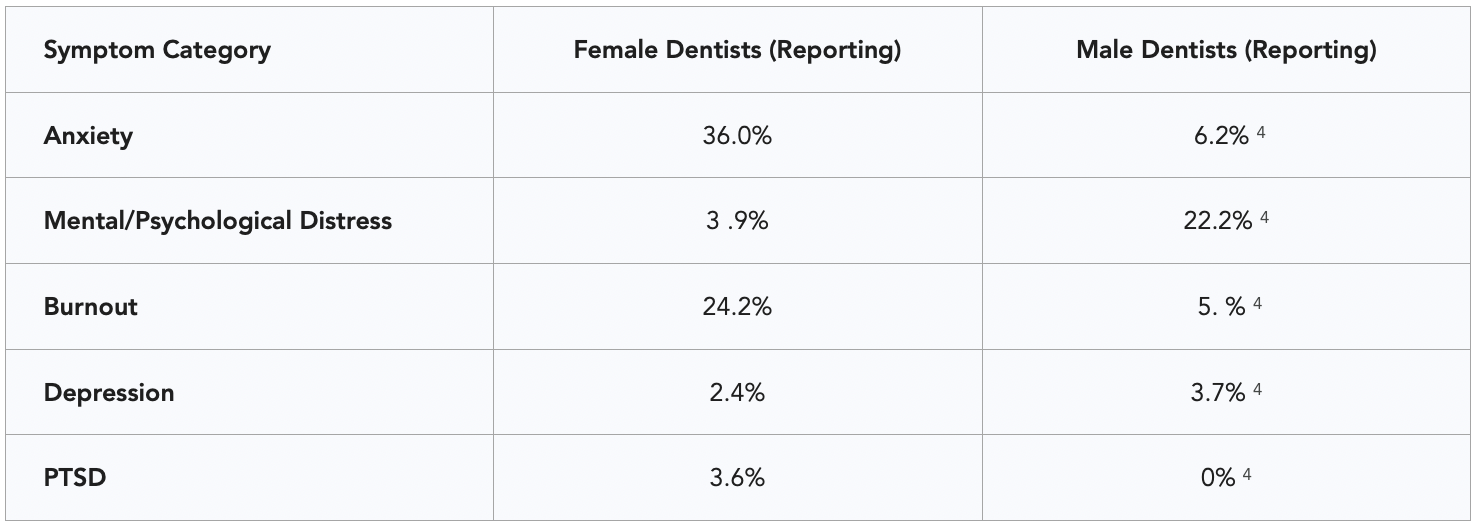
A 2024 ADA Trend Report found that 82% of dentists reported feeling major stress and career burnout.³ Recent survey data indicates that over 40% of dentists feel "defeated" or want to quit the profession altogether at least monthly.²⁰ Nearly 44% of participating dentists in a comprehensive Canadian study experienced mental health issues including depression, anxiety, and post-traumatic stress disorder.⁴
The burden is not shared equally. Female dentists are disproportionately affected, reporting a 50% rate of mental health issues compared to 37% for their male colleagues.⁴ Anxiety symptoms are more than twice as common in female dentists (36%) as in males ( 6.2%), often driven by the dual pressure of professional excellence and disproportionate caretaking responsibilities at home.⁴
Prevalence of Mental Health Symptoms in Canadian Dentists
The Loneliness of the "Dental Machine"
Professional isolation is a recurring theme among those struggling with burnout. Many dentists, particularly those in solo or rural practices, feel that they "work like machines" with no downtime and no let-up.³⁵ The lack of psychological safety and a supportive collegial environment, combined with the burden of personal responsibility for both the clinical outcome and the business survival of the practice, leads to a state of chronic, unrelieved stress.⁴ For those in the UK under the NHS model - which many Canadian practitioners see as a potential future trajectory - exhaustion has reached the point of suicidal ideation, driven by unmanageable demand and a target-driven culture.³⁵
Synthesizing the Future of the Profession
The evolution of dentistry over the last fifty years has effectively moved the professional needle from a focus on clinical judgment to a focus on regulatory and economic survival. The modern dentist in Ontario and across North America is practicing within an ecosystem that paradoxically rewards timidity and punishes innovation.
When the primary emotional center of a profession becomes fear - fear of the governing authority, fear of a one-star review, fear of an unmanageable debt load - the nature of care itself changes. The rise of defensive dentistry is a signal that the system designed to protect patients is now effectively reducing their access to experienced, confident, and integrated care.
Without a fundamental shift in the regulatory philosophy - away from punitive "checkpoints" and toward a model that supports professional judgment and clinician well-being - the attrition of talent from the field is likely to accelerate. Bright, capable individuals who enter dentistry with the goal of being healers are instead being trained as risk managers. The long-term sustainability of the profession depends on whether the systemic drivers of stress can be mitigated, allowing the practitioner to once again ask, "What is the best thing for this patient?" rather than "How can I defend this if I am investigated?".
Works cited
General research
The Past and Future Evolution of the Dental Workforce Team - AAPD, accessed March 28, 2026, https://www.aapd.org/assets/ /7/Solomon_past_future_evolution_workforce_JDE_20 2.pdf
ADA extends Well-Being Index to dental team members - ADA News, accessed March 28, 2026, https://adanews.ada.org/ada-news/2025/july/ada-extends-well-being-index-to-dental-team-members/
Dentists' Mental Health: Challenges, Supports, and Promising Practices - PMC - NIH, accessed March 28, 2026, https://pmc.ncbi.nlm.nih.gov/articles/PMC 894879/
The Evolution of Dentistry in North America: 50 Years of Progress - Burlington Heights Plaza, accessed March 28, 2026, https://burlingtonheightsplaza.com/the-evolution-of-dentistry-in-north-america-50-years-of-progress/
Dental Practice Models in the USA and Canada: Differences, Commonalities, and Growth Strategies, accessed March 28, 2026, https://www.curvedental.com/dental-blog/dental-practice-models-in-the-usa-and-canada-a-look-at-differences-commonalities-and-growth-strategies
Dental education and practice: past, present, and future trends - PMC, accessed March 28, 2026, https://pmc.ncbi.nlm.nih.gov/articles/PMC 06 397/
How Dental Technology Has Changed in the Last 50 Years, accessed March 28, 2026, https://www.pearlstreetdental.com/blog/general-dentistry/how-dental-technology-has-changed-in-the-last-50-years/
Inflation's impact on dentistry: 6 notes | Dental News, accessed March 28, 2026, https://www.beckersdental.com/dentists/inflations-impact-on-dentistry-6-notes/
Practice Ownership Trends in Dentistry - A New Look at Old Data - American Dental Association, accessed March 28, 2026, https://www.ada.org/-/media/project/ada-organization/ada/ada-org/files/resources/research/practice_ownership_trends_dentistry_new_look_.pdf?rev= 54425a 69bd475bace40fa20e08c098&hash=FE4D60F4A6A25920B4 264CCEE4F4B C
Mis/Disinformation in Dentistry: A Growing Threat to Patient Care and Professional Credibility - American Association of Endodontists, accessed March 28, 2026, https://www.aae.org/specialty/mis-disinformation-in-dentistry-a-growing-threat-to-patient-care-and-professional-credibility/
Experience with an aggressive patient is nothing new for most dentists, accessed March 28, 2026, https://www.dentalproductsreport.com/view/experience-with-an-aggressive-patient-is-nothing-new-for-most-dentists
Most Dentists Have Experienced Aggression from Patients - New York University, accessed March 28, 2026, https://www.nyu.edu/about/news-publications/news/2020/october/dentists-aggression-from-patients.html
Practice Ownership Trends in Dentistry A New Look at Old Data - American Dental Association, accessed March 28, 2026, https://www.ada.org/-/media/project/ada-organization/ada/ada-org/files/resources/research/hpi/practice_ownership_trends_dentistry_new_look_old_data.pdf
The Dental Practice Fiscal Squeeze: A Look at the Numbers - FinMkt, accessed March 28, 2026, https://www.finmkt.io/blog-posts/the-dental-practice-fiscal-squeeze-a-look-at-the-numbers
Average Dental Practice Overhead: Benchmarks and Insights - Overjet, accessed March 28, 2026, https://www.overjet.com/blog/average-dental-office-overhead-complete-breakdown-by-practice-size
2025's biggest hurdles for dentists | Dental news, accessed March 28, 2026, https://www.beckersdental.com/benchmarking/2025s-biggest-hurdles-for-dentists/
Economic Outlook and Emerging Issues in Dentistry 2nd Quarter, 2024 - American Dental Association, accessed March 28, 2026, https://www.ada.org/-/media/project/ada-organization/ada/ada-org/files/resources/research/hpi/jun2024_hpi_economic_outlook_dentistry_main.pdf
The Daily - Study: Cost-related avoidance of oral health services, accessed March 28, 2026, https://www 50.statcan.gc.ca/n /daily-quotidien/2502 2/dq2502 2a-eng.htm
Feeling burned out? You're not alone - ADA News - American Dental Association, accessed March 28, 2026, https://adanews.ada.org/ada-news/2024/april/feeling-burned-out-you-re-not-alone/
Infodemics and health misinformation: a systematic review of reviews - PMC, accessed March 28, 2026, https://pmc.ncbi.nlm.nih.gov/articles/PMC942 549/
The Impact of Social Media Misinformation on Mental Health - Lebanon Valley College, accessed March 28, 2026, https://www.lvc.edu/news/the-impact-of-social-media-misinformation-on-mental-health/
The role of social media misinformation in dental pain | DrBicuspid.com, accessed March 28, 2026, https://www.drbicuspid.com/dental-specialties/orofacial-pain/podcast/ 58 4529/the-role-of-social-media-misinformation-in-dental-pain
Online Dental Misinformation S6E08, accessed March 28, 2026, https://www.ada.org/publications/dental-sound-bites/season-6/online-dental-misinformation-s6e08
Exploring How People Interact With Dental Misinformation on Social Media: A Cross-Sectional Study - PMC, accessed March 28, 2026, https://pmc.ncbi.nlm.nih.gov/articles/PMC 0956376/
Report for removing negative review - Google Business Profile Community, accessed March 28, 2026, https://support.google.com/business/thread/354598939/report-for-removing-negative-review?hl=en
How to report someone who has been forcing me to provide dental services at a certain pricing. - Google Business Profile Community, accessed March 28, 2026, https://support.google.com/business/thread/39 234024/how-to-report-someone-who-has-been-forcing-me-to-provide-dental-services-at-a-certain-pricing?hl=en
Protect your practice's reputation | American Dental Association, accessed March 28, 2026, https://www.ada.org/resources/practice/legal-and-regulatory/managing-dental-practice-online-reviews
Negative Online Reviews of Your Dental Practice Can Sting, But an Ill-Advised Response Can Cause You Even More Pain - DDS Lawyers, accessed March 28, 2026, https://www.ddslawyers.com/negative-online-reviews-of-your-dental-practice-can-sting-but-an-ill-advised-response-can-cause-you-even-more-pain
The Hidden Cost of a Bad Online Reputation (And What You Can Do About It), accessed March 28, 2026, https://www.dentalrevenue.com/2025/07/28/the-hidden-cost-of-a-bad-online-reputation/
Dentists report increasingly aggressive behavior from patients: 4 things to know, accessed March 28, 2026, https://www.beckersdental.com/dentists/dentists-report-increasingly-aggressive-behavior-from-patients-4-things-to-know/
About Half of All Dentists Have Experienced Patient Aggression - Dentistry Today, accessed March 28, 2026, https://www.dentistrytoday.com/about-half-of-all-dentists-have-experienced-patient-aggression/
Evaluation of dentists' malpractice fears and defensive dentistry attitudes: a scale development - PMC, accessed March 28, 2026, https://pmc.ncbi.nlm.nih.gov/articles/PMC 2083 0 /
Dentists' Views About Defensive Dentistry: A Cross-sectional Study, accessed March 28, 2026, https://anatolianjmed.org/articles/dentists-views-about-defensive-dentistry-a-cross-sectional-study/terh.20 4.70288
Two-thirds of dental professionals “burnt out and exhausted”, accessed March 28, 2026, https://www.dentalprotection.org/uk/articles/two-thirds-of-dental-professionals--burnt-out-and-exhausted