

2026-08-21
TMJ Night Guard Therapy: What Happens When the Appliance Changes Jaw Position?
Written by Dr. Agatha Bis
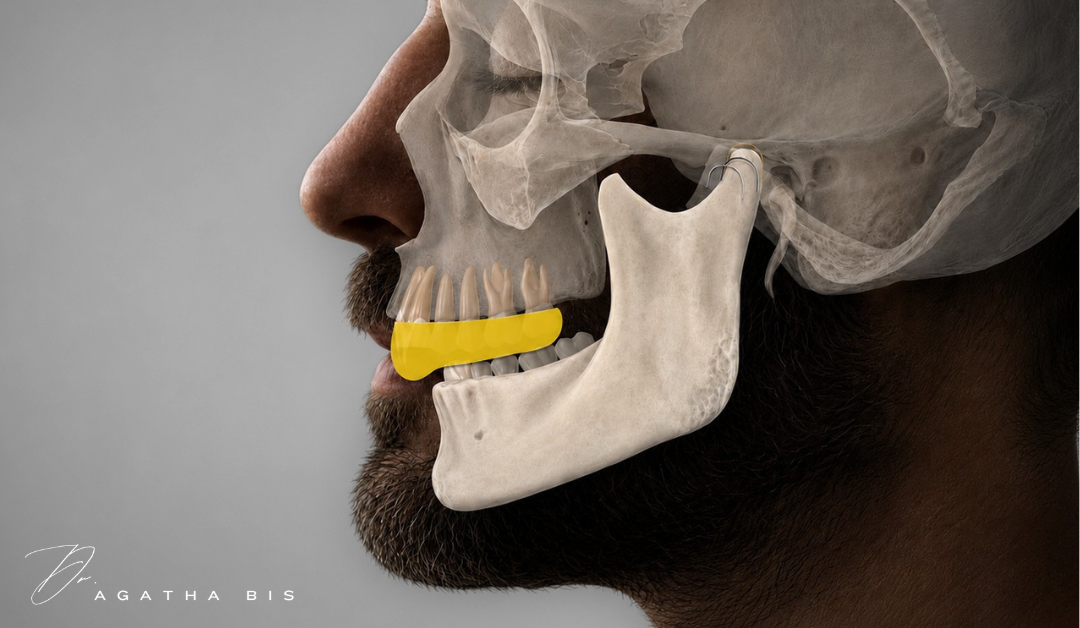
One of the most important things I look at when evaluating an appliance is surprisingly simple.
I ask the patient to close.
Then I look at where the mandible goes.
That may sound obvious, but many night guards are evaluated almost entirely by looking at the appliance itself.
Does it fit?
Does it stay in place?
Does it cover the teeth?
Is the material thick enough?
Those are useful questions.
But when we are talking about TMJ night guard therapy or TMD splint design, they are not enough.
The mandible is attached to the skull through two joints.
Every time the patient closes into an appliance, the condyles (condyle is the head of the jaw joint) are participating in that movement.
So when we change the surface the teeth close against, we also need to understand what we are doing to the jaw.
Think About What Is Happening Inside the Joint
The condyle is the rounded upper portion of the mandible. It sits within the joint, and between the condyle and the temporal bone is the articular disc.
That disc moves as the jaw opens and closes.
The surrounding ligaments help maintain its relationship with the condyle, while the tissues behind the joint are not designed to tolerate the same type of sustained loading as the disc.
Now imagine a patient clenching repeatedly throughout the night.
If the appliance is not contacting evenly, or if it supports the mandible in a position that loads one joint differently from the other, those forces are not simply disappearing into the plastic.
They are being transmitted through the system.
That is why I become concerned when a patient begins telling me that their jaw feels worse after wearing a night guard.
"My Jaw Is Tighter in the Morning"
This is one of the first questions I ask.
Did the patient wake up with jaw tension before wearing the appliance?
And what happens now?
If the patient consistently wakes with increased tension, increased pain or a feeling that the jaw has been working all night, I want to reassess the appliance.
The patient is giving us information.
The same is true when a patient develops a new click or notices that an existing click has become more obvious after starting the appliance.
I do not want to simply say, "Give it more time."
I want to know what changed.
Why Jaw Position Matters
Ask the patient to bite in their normal position.
Then place the appliance and have them close again.
Look at the relationship.
What happened to the lower jaw?
If the appliance is allowing or encouraging the mandible to sit farther back, the condyles are also being affected by that change in position.
And if the patient spends hours every night clenching into that position, we need to understand the effect of that loading.
This is one of the reasons I believe jaw position should be intentional.
It should not simply be whatever position happened to be captured when the appliance was fabricated.
Clicking Is Not Just a Sound
When a patient tells you their jaw is clicking, it is easy to focus only on the noise.
I am more interested in what the noise represents mechanically.
In a clicking joint, the relationship between the disc and condyle is changing during movement.
The sound may occur as the structures move through that altered relationship during opening or closing.
If the clicking starts after an appliance is introduced, or becomes noticeably worse, it deserves evaluation.
That does not mean every click will progress or every night guard will damage a joint.
It means a new mechanical change should not be ignored simply because the patient is wearing an appliance that was intended to help them.
Uneven Contact Changes the Load
Jaw position is only part of the picture.
The other question is what happens when the patient actually contacts the appliance.
If several teeth are contacting heavily while others are barely touching, the closure is not being supported evenly.
Now imagine the patient clenching into that pattern repeatedly overnight.
This is why I always want the appliance checked clinically.
It is not enough that it looked balanced in the laboratory.
It needs to be balanced in the patient's mouth.
A TMD Splint Should Not Be Chosen by Name Alone
Dentists often search for the best TMD splint design.
Flat plane.
Anterior bite plane.
NTI.
Full coverage appliance.
There are many designs.
But before deciding which design to use, I want to know what problem I am trying to solve.
Is this primarily a muscle problem?
Is the joint involved?
Is there clicking?
Is there restricted opening?
Is the patient showing significant wear?
Where does the mandible naturally go?
Without answering those questions, the name of the appliance does not tell us whether it is appropriate.
What I Want Dentists to Take From This
A night guard is not just something that sits over the teeth.
It creates a new surface for the mandible to close against.
That means it influences the muscles, the occlusion and the joints.
When a patient reports more pain, more morning tightness or a new click after beginning night guard therapy, do not focus only on whether the appliance still fits.
Look at the system again.
Look at the material.
Look at the mandibular position.
Look at the contacts.
The patient may be telling you that something about the appliance needs to change.
If you want to better understand how mandibular position, joint mechanics, and occlusion influence your treatment decisions, TMJ Essentials takes you through the clinical concepts Dr. Bis uses every day.