

2026-09-04
Dentist-Made Night Guard vs Over-the-Counter: Why "Custom" Does Not Automatically Mean Correct
Written by Dr. Agatha Bis
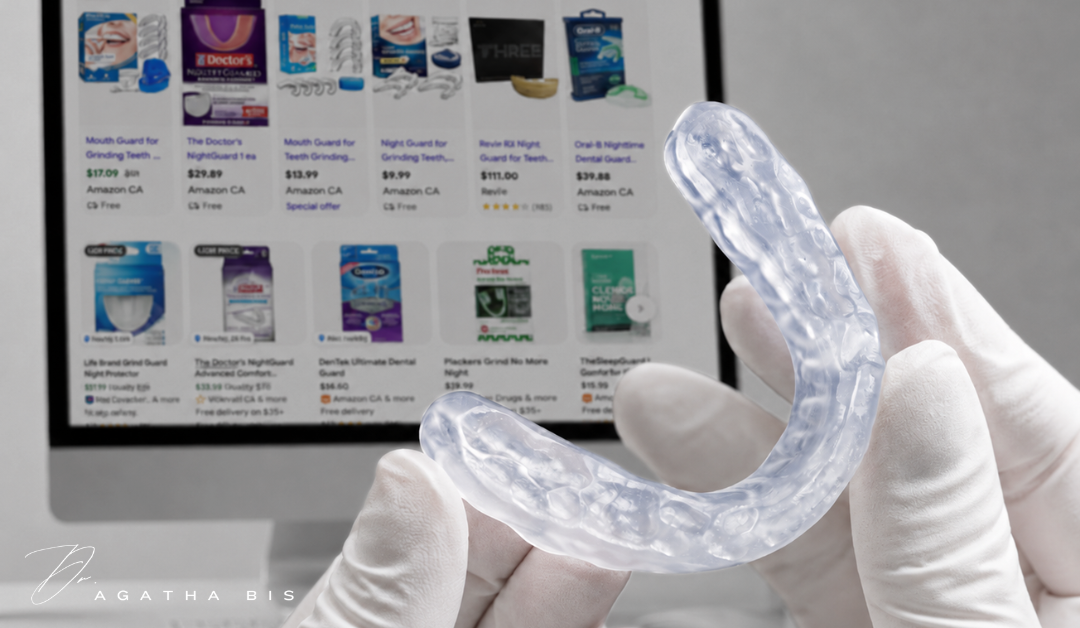
Most dentists would agree that an over-the-counter night guard and a custom dental appliance are not the same thing.
The custom appliance can be made from an accurate impression or scan.
We can control the material.
We can control the design.
We can adjust it.
All of that gives us an enormous advantage.
But I think we need to be careful with one assumption.
Dentist-made does not automatically mean correctly designed or correctly adjusted.
This is one of the most important messages I want dentists to understand about night guards.
Because the same three problems I see in an over-the-counter appliance can also exist in an appliance made in a dental office.
Why Over-the-Counter Night Guards Commonly Fail
Most over-the-counter night guards are generic.
They are made to adapt to many different mouths, rather than one specific patient's occlusion and mandibular relationship.
Many are also soft or resilient.
So now we have two immediate concerns.
The material may encourage some patients to chew or clench harder against the appliance, and the appliance has not been individually adjusted to how that patient closes.
Then we have contact.
Because the guard is generic, there is no guarantee that every tooth is contacting evenly.
One area may contact heavily.
Another may not touch at all.
For a patient who is clenching throughout the night, those details matter.
But the Same Problems Can Happen With a Custom Night Guard
This is where the discussion becomes more uncomfortable.
A custom appliance may be beautifully fabricated from a hard material.
It may fit perfectly.
But if it supports the jaw too far back, we have not solved the problem.
Or the mandibular position may be appropriate, but the contacts were never properly adjusted.
Now some teeth are carrying much more load than others.
The appliance is still custom.
It is still dentist-made.
And it can still be wrong.
That is why I do not believe the words "custom" or "dentist-made" should give us false reassurance.
The label does not guarantee the outcome.
The clinical evaluation does.
Material
The first thing I look at is what the appliance is made from.
Is it soft?
Is it hard?
How is the patient responding to that surface?
If the patient begins waking up with a tighter jaw after starting the appliance, I want to know why.
The fact that the appliance came from a dental office does not make that symptom irrelevant.
Jaw Position
Then I look at mandibular position.
Have the patient close normally.
Look at the relationship.
Then insert the appliance and have them close again.
Where did the mandible go?
If the appliance is changing the position of the lower jaw, that should be intentional.
We should know why we are doing it.
I do not want the patient's jaw position to be an accidental consequence of appliance fabrication.
Even Contact
The third issue is contact.
This is one of the simplest things to evaluate and one of the easiest things to overlook.
When the patient closes into the appliance, are all of the teeth participating?
Or are several teeth touching while others have little or no contact?
A simple thin marking material can tell you a great deal.
The important part is not simply seeing marks.
It is understanding whether the patient is closing onto a stable, evenly supported surface.
If the contacts are uneven, adjust them.
And then check them again.
What the Patient Tells You After Delivery Matters
I would also tell patients exactly what I want them to pay attention to.
Does the jaw feel tighter in the morning?
Is there more pain?
Did clicking start after wearing the appliance?
Did existing clicking become worse?
Does the bite feel different when the appliance is removed?
These are not complaints we should automatically dismiss.
They are clinical information.
A properly fabricated appliance still needs follow-up because the patient's response is part of the treatment.
The Three Failure Points Are the Same
This is really the heart of the issue.
An over-the-counter appliance commonly fails because of the wrong material, the wrong jaw position or uneven contact.
But a dentist-made appliance can fail for exactly the same reasons.
It can be fabricated from a harder material but support the mandible in the wrong position.
It can support the jaw appropriately but have uneven contacts.
It can look excellent and still make the patient feel worse.
That is why I keep returning to the same three questions:
What is it made from?
Where is the jaw?
How are the teeth contacting?
When those three things are evaluated carefully, the appliance begins to serve the patient rather than simply cover the teeth.
Custom Is the Beginning, Not the Guarantee
Dentists have an enormous advantage over an over-the-counter product.
We can diagnose.
We can examine the joint.
We can palpate the muscles.
We can evaluate the bite.
We can choose the material.
We can control mandibular position.
We can adjust the appliance.
That is where the value of a dentist-made night guard actually lies.
Not in the fact that it came from a dental office.
But in the clinical thinking that went into it.
A custom appliance should be better because the dentist understands the patient better.
That is the standard we should be aiming for.
A custom appliance is only as good as the diagnosis behind it. TMJ Essentials helps dentists move beyond simply making a night guard and understand the joint, muscles, occlusion, and mandibular position influencing the case.