

Hands-On Dental Course | Level 4
Plan the Complex Case
When to Use an Orthotic, and Where to Position the Mandible for Complex Cases
Know when a complex case calls for an orthotic, and the exact mandibular position to adjust it to.
Level 4 is where treatment planning takes on complex cases, and where the orthotic becomes a treatment decision rather than a default. Two questions are central: when does a complex case call for an orthotic, and what mandibular position should that orthotic be adjusted to. The answers come from the diagnosis, and the adjustment is how they are executed.
You will treatment-plan complex cases and define the role of Phase 1 orthotic therapy within the larger plan. You will determine the target mandibular position the case requires, the corrected position toward the Optimal Physiologic Position, and verify it with TENS and an accurate bite registration. From there, the level goes into the occlusal adjustment in depth: the contacts on the orthotic, their timing and force read with TScan, the guidance, and the interferences that must be removed. Choosing to use an orthotic, and knowing the position to build it to, is what separates orthotic therapy that resolves a complex case from an appliance that sits in the mouth without correcting anything.
Learning objectives
Upon completion, participants will be able to:
Treatment-plan a complex case and define the role of Phase 1 orthotic therapy within the larger plan.
Determine when an orthotic is indicated for a complex case, and when another route is appropriate.
Establish the target mandibular position the case requires, and verify it using TENS and an accurate bite registration.
Deliver the orthotic and establish even, simultaneous bilateral contacts in Optimal Physiologic Position.
Read occlusal contacts, lateral and balancing interferences on the orthotic for location, timing, and force, and correct them.
Use TScan to analyze the timing and distribution of occlusal force and fine-tune the adjustment.
Build the guidance the case requires so that the occlusion no longer drives muscle activity, and the musculature is permitted to relax, lengthen, heal, and stabilize.
Adjust the orthotic so that it reliably reproduces the target mandibular position.
Course details
Location: Smiles by Bis
710 Dorval Dr #220, Oakville, ON L6K 3V7
Date: To be announced
CE Credits: 14
Dentist tuition: $4,995 CAD
Hygienist or assistant: $980
Format: Two-day, in-person course
Course content
-
The complex case demands a plan before a procedure. This module teaches you to build that plan: the sequence of correction, the role Phase 1 plays within it, and where the case is going before you place a single appliance. The plan is what the adjustment serves; without the plan, the orthotic has no defined objective.
-
The orthotic is not a default, and not every complex case calls for one. This module teaches the indication: which findings call for repositioning the mandible with an orthotic, and which call for another route. Knowing when not to use an orthotic is as much a part of the skill as knowing when to use one.
-
An orthotic is only as good as the position you adjust it to, and it resolves pain and permits the joint to heal only when that adjustment is carried through completely. The skill is in the adjustment, not in the appliance. An orthotic adjusted to an incomplete position holds the mandible close to where it already was, and the condyle does not arrive at the target.
Material is removed where the mandible indicates, not where it is convenient to reach. That requires you to move the mandible. You guide the patient through the excursive and protrusive slides, recognize when the patient is not producing them, and lead them through until the contacts present themselves. A patient who guards, or who closes into the position they have held for years, will not deliver those marks unassisted. This module teaches how to direct the adjustment: which contacts to remove and in what order, how to move the mandible so the correct contacts appear, and how to verify that the position has been reached rather than approximated.
Reducing acrylic is not adjustment. Knowing where the reduction belongs is.
This module teaches you to determine the target mandibular position the case requires - the corrected position toward the Optimal Physiologic Position - using TENS to locate it and an accurate bite registration to capture it. The position is the objective; everything that follows is how you reach it.
-
The orthotic carries the occlusion now, and every contact on it matters, in every slide, in every movement. This module teaches you to deliver the orthotic and to read the contacts for location, timing, and force, establishing even, simultaneous bilateral contact, and eliminate all interferences to allow the muscles to fully relax. Uneven or mistimed contacts in any slide hold the mandible away from the target position; correcting them is the adjustment.The module also defines the limits of the image. A panoramic radiograph cannot show disc position and cannot establish condylar position or 3-dimensional shape in the fossa. It raises suspicion and directs further imaging. It does not exclude joint disease. Participants learn which findings warrant CBCT, which warrant MRI, and which warrant neither.
-
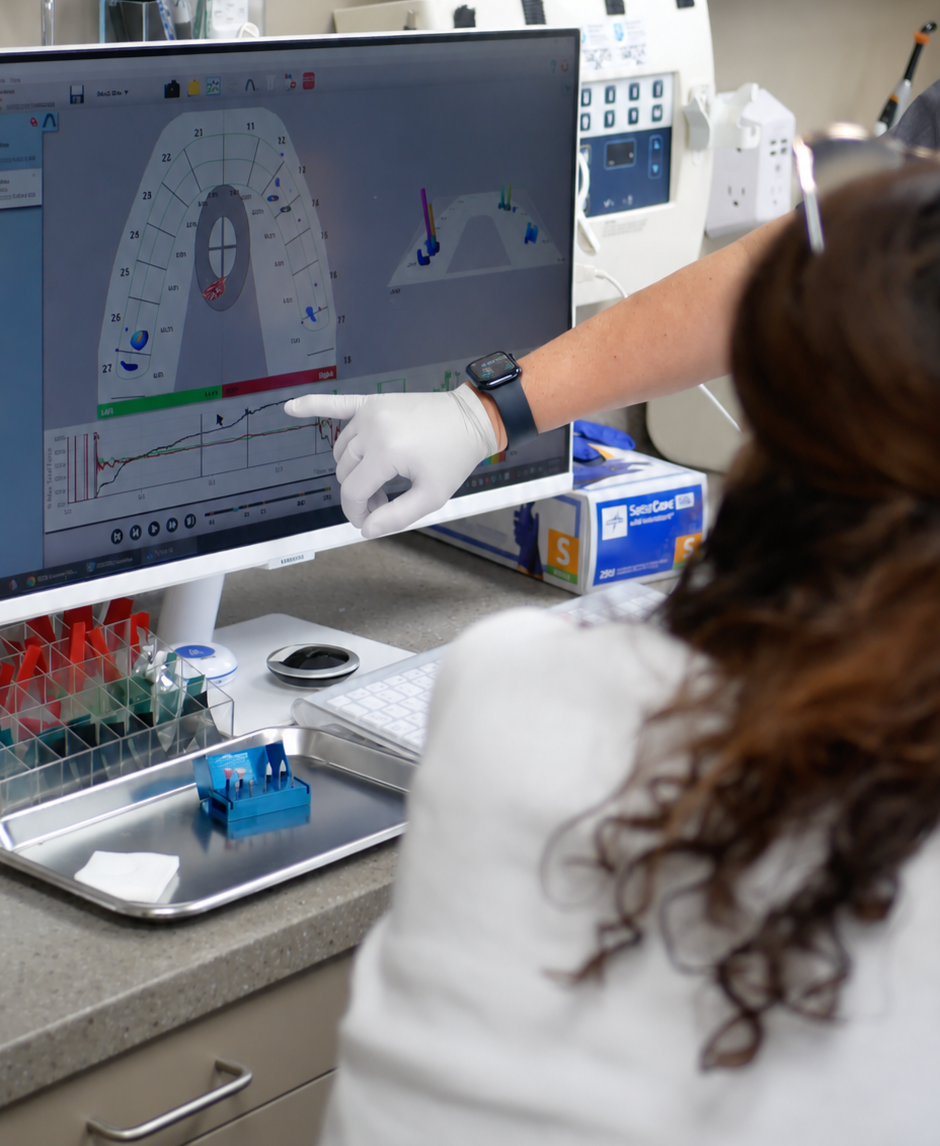
Articulating paper shows where the teeth touch. It does not show when, or how hard. This module teaches you to use TScan to read the timing and force of the contacts on the orthotic, to identify premature and high-force contacts, and to adjust toward balanced, correctly timed occlusion at the target position.
-
Guidance determines how the mandible moves against the orthotic, and interferences fight the position you are trying to establish. This module teaches you to build the guidance the case requires and to find and remove the interferences that displace the mandible or provoke parafunction, so that the orthotic reliably reproduces the target position.
This module also defines when the TScan is used and when its output should not be trusted. The instrument measures force distribution and the sequence of contact accurately. It does not tell you where the mandible is. It reports what occurred at the position the patient closed into, and early in therapy that position is neither the target position nor the same position from one appointment to the next.
Used too early, the recording is accurate and the conclusion drawn from it is wrong. A guarding patient delivers a guarded closure. The mandible has not settled. Balancing to that record removes material that will be required once the position stabilizes, and each correction chases a position that is still moving. The patient is adjusted away from the target rather than toward it, and the symptoms that follow are read as a failure of the appliance.
The module establishes the sequence. The position is determined and verified first. Reproducibility is confirmed. The TScan is then used to refine force distribution and timing within that established position. The module also covers the conditions that invalidate a recording - an unstable mandibular position, an actively guarding patient, an uncontrolled head position - and what to do at that stage of treatment instead.
A TScan used at the wrong stage of therapy is the right map in the wrong city. The readings are correct. The destination is wrong.
The interpretation covers craniocervical angulation, cervical curvature, hyoid position, posterior airway, and the sagittal and vertical skeletal relationships, and then connects them to the mandible. The mandible has no fixed skeletal support below. It is suspended between the elevator group above and the suprahyoid and infrahyoid groups below, and the hyoid is anchored downward to the shoulder girdle. Head extension and forward head carriage change the length and direction of pull of that lower group and add a posterior and inferior vector on the mandible. Rest position and the path of closure move with it.
Hands-on practical exercises
Complex-case treatment-planning workshop
Orthotic indication decision exercise
Determining the target mandibular position with TENS and bite registration
Orthotic design workflow (for doctors printing appliances in office) and laboratory communication tips (for doctors using an outside lab)
Orthotic delivery and establishing even bilateral contacts
Reading and correcting occlusal contacts by location, timing, and force
TScan analysis and force balancing on the orthotic
Building guidance and removing occlusal interferences
Adjusting the orthotic to reproduce the target position

Your Monday-morning toolkit
Every level ends with a single-page tool you can apply the next working day. It is not a course summary. It is an instrument, built for chairside use by you and your team.
Level 4 - The Target-Position Adjustment Protocol.
A one-page instrument that confirms the orthotic is indicated for the case, records the target mandibular position and how it was verified, and sets out the adjustment sequence to reach it: contacts by location, timing, and force, the TScan targets, the guidance, and the interferences to remove. It ends at the point the orthotic reproduces the target position.

Bringing a team member
The adjustment appointment requires setup: TENS, bite registration materials, TScan capture, and the records that document the position. It also requires patient preparation. The appointment runs on what the patient does in the chair, and a patient who arrives without instruction slows it down. This module teaches the communication that prepares them: what happens during the appointment, what is asked of them while it is underway, and how their participation determines the quality of the adjustment.
A team member trained here prepares and runs those steps, so your chair time is spent on the clinical judgment, the position and the adjustment, rather than on the logistics around them.
The economics of complex-case treatment
Level 4 is where the difficult case is either planned, treated, and kept, or referred out. The decisions in this level determine which. Three drivers follow from the material.
Complex cases treated, not referred away. The ability to plan and execute the difficult case keeps it in your practice. Each complex case referred out is production lost, and a patient relationship, handed to someone else.
The orthotic used when it is indicated, not by default. An orthotic placed in a case that did not need one, or adjusted to the wrong position, is time and money spent without a result. Choosing it deliberately, and building it to the correct position, is what makes Phase 1 orthotic therapy effective and productive.
Phase 1 done right carries the case to Phase 2. The finalization work follows Phase 1. When the position is correct and the case responds, it proceeds to Phase 2 — the larger case. When it is not, the patient stalls and that case is lost.
Ready to put the diagnosis into action?
Level 4 takes the complex case from treatment planning into Phase 1 therapy. Learn when an orthotic is indicated, how to establish the target mandibular position, and how to adjust the appliance so the case moves toward the intended position.
New to the Hands-On Series? Start with Level 1 to build the diagnostic foundation first.
Bridge to Level 5
Level 4 establishes the corrected position and the plan for the complex case. Level 5 follows the case beyond that point: how the patient changes over time after orthotic therapy, and Phase 2, the finalization that makes the corrected position permanent, through orthodontics, restorative and prosthodontic treatment, equilibration, or surgical referral.
Have a question before registering?
Not sure which level is right for you, what to expect, or whether you should bring a team member? Send us your question and our team will get back to you.

About the instructor
Dr. Agatha Bis has spent nearly 30 years treating complex cases in private practice with a clinical focus on TMJ disorders, occlusion, restorative dentistry, and the systems that make treatment more predictable. She is also the founder of TMJ Whisperer Academy, an educational platform built for dentists who want to understand cases more clearly, diagnose with more confidence, and practice with more control.