

2026-03-19
Anterior Wear Facets Are Not “Just Bruxism”
Written by Dr. Agatha Bis
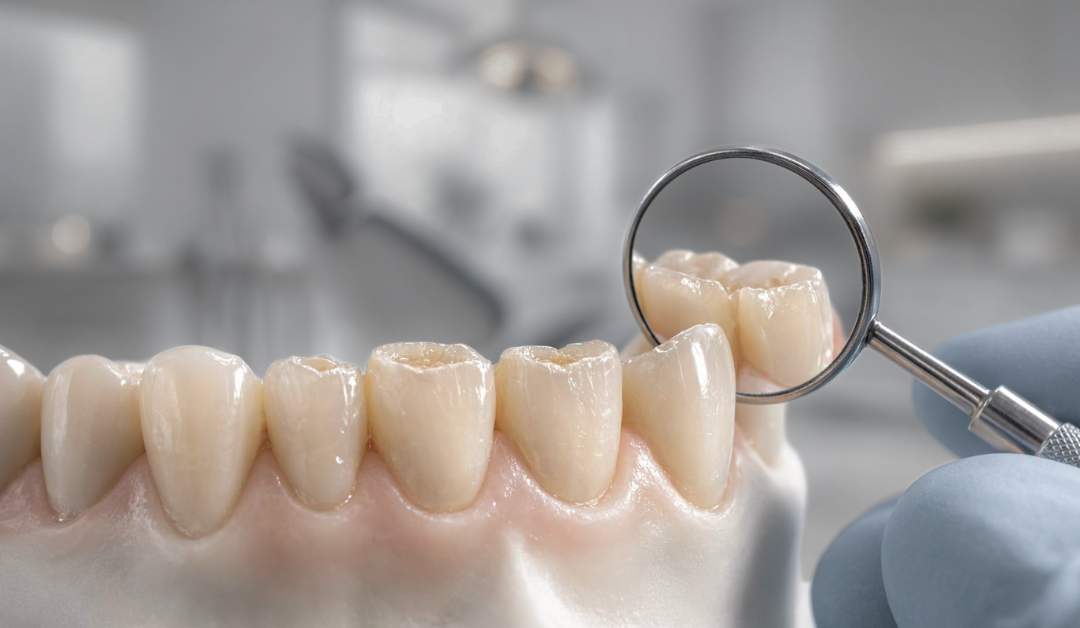
What the enamel is actually telling you
One of the most common explanations dentists give for anterior wear is simple:
“The patient grinds.”
And technically that is true.
But that explanation misses the most important clinical question:
Why is the mandible repeatedly moving in that direction?
When you look closely at anterior wear patterns, especially in retrusion cases, you often see something very specific. The wear is not random. The facets are clean, polished, and geometrically consistent.
That pattern is not just damage.
It is a record of movement.
The enamel is showing you the direction the system repeatedly tries to go.
Wear Facets Are Functional Clues
True attrition facets from parafunction have a very recognizable appearance. They are:
highly polished
sharply defined
geometrically consistent
They look very different from erosion or abrasion.
More importantly, they behave like directional markers.
They tell you how the mandible has been moving during repeated cycles of unconscious activity.
The Pattern That Often Appears in Retrusion Cases
When the mandible is habitually functioning forward of a retruded position, a very characteristic wear map often develops.
You will frequently see:
wear on the facial surfaces of the lower incisors
wear on the palatal or incisal surfaces of the upper incisors
That geometry reflects a repetitive anterior-posterior grinding pattern.
In simple terms, the mandible is repeatedly driving forward into the anterior teeth.
What This Really Means
These patterns often indicate something deeper than bruxism alone.
They may indicate that the mandible is functioning anterior to the patient’s maximal intercuspation.
During unconscious activity, when cortical control is reduced, the neuromuscular system may repeatedly guide the mandible toward a position that reduces strain or supports airway patency.
That movement leaves a record.
And that record is the wear pattern you see on the anterior teeth.
What to Do Before Restoring Anything
When you see anterior wear facets that follow a clear pattern, they should trigger a diagnostic pause.
Before restoring the teeth, document what the system is showing you.
A simple clinical sequence can be very informative:
Photograph and chart the wear facets.
Ask the patient to slide forward and see if those facets align.
Observe the anterior-posterior shift required for alignment.
Measure the discrepancy between MIP and the facet-aligned position, both horizontally and vertically.
This step often reveals whether the occlusion and the neuromuscular system are operating in the same coordinate.
Why This Matters for Restorative Dentistry
If the patient’s system is repeatedly trying to function anterior to MIP, restoring the teeth into a retruded coordinate without verification can create ongoing conflict.
That conflict may show up as:
persistent muscle activity
increased joint loading
fracture or failure of restorations
The dentistry may be technically excellent.
But it may still be built into the wrong coordinate.
The Clinical Takeaway
When anterior teeth show clean, repeatable wear patterns, the patient is not simply grinding.
The system is compensating.
The enamel has already documented the movement pattern.
Your role is not only to restore the damaged teeth.
Your role is to determine where the system is trying to function before you lock the patient into a position that may be working against it.
Join the Study Club
Learn how to read anterior wear facet patterns as functional “vectors,” measure the MIP discrepancy, and make safer restorative decisions before you lock the bite into conflict.